July 26, 2026 at 9:17 am EDT
“I clean my kitty's bowl every day. My kitty is about 3 years old - and last night, I noticed she was trying to go to the bathroom but couldn't. After googling, I rushed her to an all night vet, which ended up costing me $1,400. Kidney failure due to dehydration. I had no idea that her current bowl was steering her away from drinking as much as she needed." —Arya Jane
Most cat owners have never been told what chronic under-drinking can lead to. Fewer still know the one thing in the house that's quietly making it worse.

House Cats are terrible at drinking water. That's not a personality flaw. It's biology.
Cats descend from desert animals. They evolved to get most of their moisture from prey — food that was around 70% water — not from standing water.
So they never developed a strong thirst drive. A dog that's low on water gets thirsty and drinks. A cat that's low on water often just… doesn't.
Now take that cat, put her in a modern home, feed her dry kibble, and set down a bowl of still water.
She won't make up the difference. She'll quietly drink less than she should — for months. For years. And you'll never see it, because there's nothing to see.

Here's why that matters.
When a cat drinks too little, her urine becomes more concentrated. Veterinary sources — including Cornell's Feline Health Center and the Merck Veterinary Manual — consistently identify adequate water intake as an important and modifiable part of feline urinary health.
That word — modifiable — is the whole point. So much of a cat's health is genetics and luck. Hydration is one of the few things that's actually in your hands, every single day.
And most owners have no idea their cat is quietly running low — because a cat that under-drinks doesn't act thirsty. She just... doesn't drink. For months. For years. And you'd never see it, because there's nothing to see.
"I was under the impression he was constipated or something because he was straining in the litterbox and yelled when you touched his stomach." — cat owner, r/cats
"My guy is about 4 years old and last night I noticed he was trying to go to the bathroom but couldn't. After googling I rushed him to an all night vet." — cat owner, r/CatAdvice
"My cat had bladder crystals and if I wasn't on it all the time I might not have noticed the empty box and him going in and out trying to pee every 10 minutes." — cat owner, r/cats

These are real numbers, from real owners, in the last four years.
"I was told treatment would be $4-5000. I could barely afford it but wasn't about to watch him die so I agreed."
"Vet bill was estimated 2k-4k for overnight treatment with a low chance of surviving the anesthetic due to high potassium levels."
"This just happened to my bro and his cat! 4,000 dollar emergency vet bill."
"It was 1200 vet bill but he turned 5 this year."
"I had a cat die from that. I still blame myself for not getting him treatment sooner."
Read that last one again.
Because that's the part nobody prepares you for. It isn't the money. It's the sentence that comes after — I still blame myself.
We want to be very clear about something.
We are not telling you a water fountain prevents urinary disease. It does not. Nothing on this page is veterinary advice. If your cat is straining, crying, or unable to urinate, that is an emergency — stop reading and call a vet.
We're telling you this because hydration is one of the very few things in your cat's health that is completely within your control. It's not genetics. It's not luck. It's the water she drinks every day.
And right now, there's a decent chance something in your kitchen is stopping her.
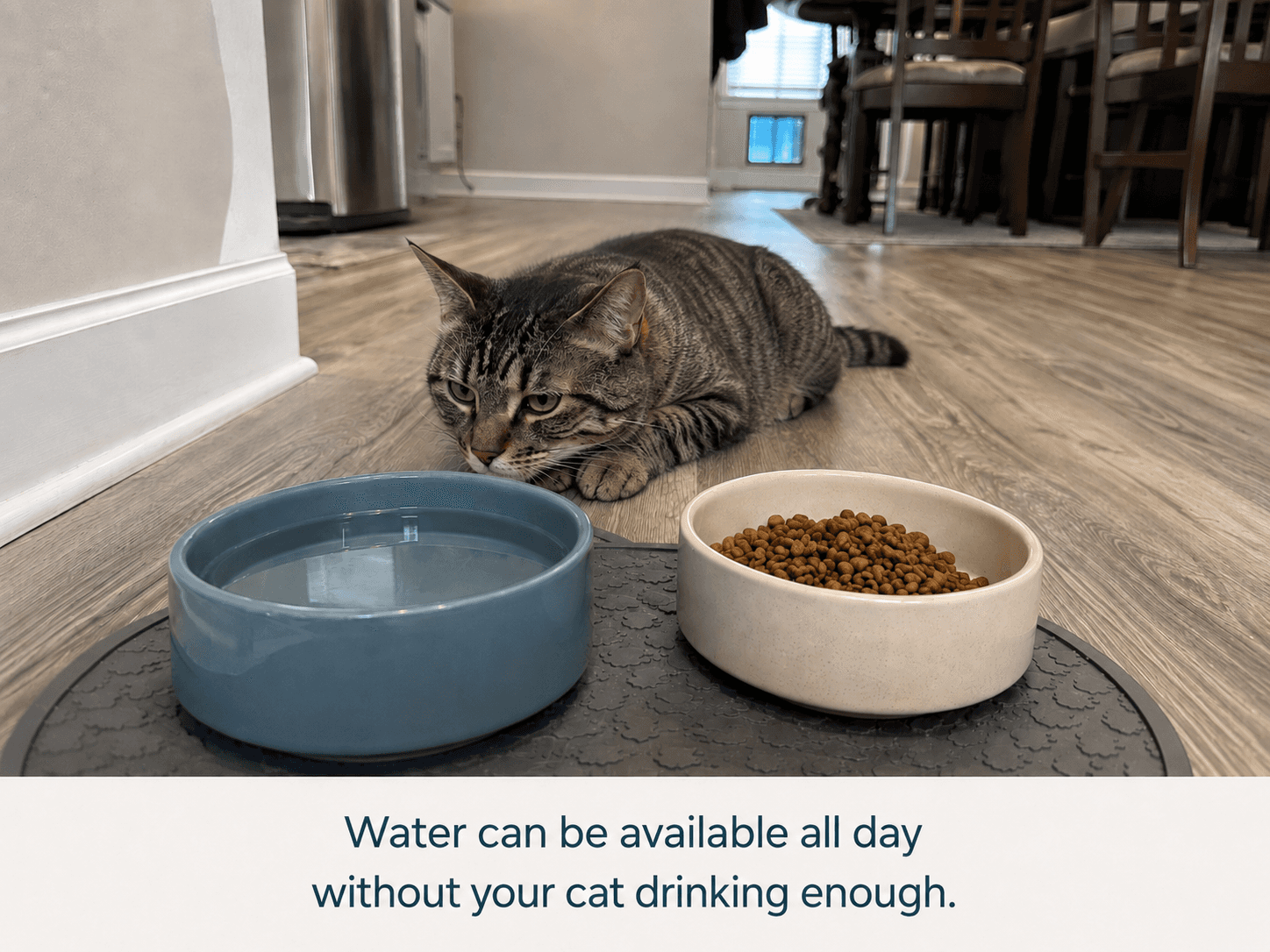
She'll drink from the tap, the shower, your glass. Just not her bowl.
You know the routine.
She sits by the bathroom faucet and waits for you. She jumps into the sink the second you walk in. She sticks her head under the shower after you step out. She drinks from the glass on your nightstand — the one you were about to drink from.
And her actual water? Full. Untouched. All day.
"She only drinks from the faucet and will sit until you turn it on for her." — r/cats
"My Roxanne sits in the bathroom sink and drinks from the faucet. Drives me nuts." — r/cats
Most of us laugh it off. She's spoiled. She's dramatic. She's a cat.
She's not being difficult. She's being specific.
She's telling you — every day, in the only language she has — that there is something about her water she does not want. And she will go stand in a sink to avoid it.
So what is she avoiding?
It isn't the water. It's what the water is sitting in.
Plastic is porous.
Every wash leaves microscopic scratches. Every day, those scratches collect oils, saliva, food residue, and bacteria. They're too small to see and too deep to scrub. Over weeks, they build into a slick invisible layer — biofilm. That's the "slime" every fountain owner complains about and nobody can get rid of.
And plastic holds odor. Not a smell you can detect. But your cat's sense of smell is roughly fourteen times more sensitive than yours.
So you're looking at a bowl that appears perfectly clean. She's smelling something else entirely.
That's not fussiness. That's a cat with a working nose.
"Plastic bowls and fountains always developed this smell that never fully went away, even after cleaning."
"My last fountain molded on the plastic bits even with weekly cleanings. Anyone know of an actual QUALITY fountain without any plastic?"
"We use no plastic dishes with our cat kids as they hold bacteria and can contribute to illnesses of unknown origin."
You can scrub it weekly. You can run vinegar through it. You can change the water daily.
You cannot scrub a scratch clean.

8 signs the bowl is the problem
Go look at your cat's water right now. Two or more of these, and this is your cat:
✓ A slippery film inside the bowl within days of washing it
✓ A faint musty or sour smell when you refill it
✓ She drinks from the faucet, shower, toilet, or your glass — but not her bowl
✓ You bought a fountain, she used it for a week, then stopped
✓ Black flecks or discoloration in the water
✓ You scrub weekly with vinegar and the slime still comes back
✓ Her bowl is visibly scratched, cloudy, or worn
✓ Black specks, a rough patch, or breakouts on her chin
Go look at your cat's water right now. Two or more of these, and this is your cat:
✓ A slippery film inside the bowl within days of washing it
✓ A faint musty or sour smell when you refill it
✓ She drinks from the faucet, shower, toilet, or your glass — but not her bowl
✓ You bought a fountain, she used it for a week, then stopped
✓ You've replaced the fountain pump once. Or twice. Or more.
✓ Black flecks or discoloration in the water
✓ You scrub weekly with vinegar and the slime still comes back ✓ Her bowl is visibly scratched, cloudy, or worn ✓ Black specks, a rough patch, or breakouts on her chin
We built the fountain the internet kept asking for.
We didn't start with a product. We started with about a thousand reviews of the fountains people already owned.
The complaint was never "my cat won't drink."
It was always "my cat won't drink from this."
And under the one-star reviews, the same words surfaced again and again. Slime. Mold. Smell. Chin acne. Scratches.
Plastic. Plastic. Plastic.
So we built RipplePaws Flow One around the one thing the market was actually asking for.
304 food-grade stainless steel — the material used in surgical instruments and commercial kitchens.
Nonporous. It doesn't scratch the way plastic does, so biofilm has nowhere to take hold.
Odorless. Steel doesn't absorb smell. She gets water that smells like water — which, to a nose fourteen times sharper than yours, is the whole ballgame.
Actually cleanable. No scratches you can never reach. Wipes down in under five minutes.
"The stainless steel is the big selling point, and honestly it's earned. Plastic bowls and fountains always developed this smell that never fully went away, even after cleaning. This doesn't. No weird taste, no staining, and way less slime buildup between washes."
Then we gave her the water she's been asking for.
A faucet-style flowing stream — the same moving water she's been climbing into your sink to get.
3-stage filtration: pre-filter sponge for hair and debris, activated carbon to reduce chlorine taste and odor, ion-exchange resin to help soften the water.
Under 20dB. Quieter than a whisper. It won't wake you and it won't spook her.
3.2 litres. Enough for multiple cats, several days at a time.

"But what if my cat won't use it?"
It's the first thing everyone asks. It's why people put this off for months. And it's fair — you've already bought a fountain your cat ignored, and you're not doing that twice.
So here's the deal.
Try it for 30 days. If she won't use it, send it back. Full refund.
Not store credit. Not a restocking fee. Your money back.
We can afford to say that, because we already know what she wants. She's been telling you every time she jumps in your sink.
Put the numbers side by side.
A fountain is insurance against a vet bill. It isn't, and anyone who tells you otherwise is selling you something dishonest.
But hydration is the one lever you actually hold. And it costs less than one night at the emergency vet.
RipplePaws Flow One — 304 stainless steel fountain
4 replacement filter sets included + The Cat Hydration Guide — our vet-informed ebook, free with purchase + Free express shipping, from the United States + 30-day money-back guarantee
$149.99 $89.99
One less thing on your conscience. One more reason for your cat to drink.
